The "Chornobyl Guide" Course
Chornobyl University's first educational program: training guides for the Chornobyl Zone, with scientists and practitioners.
The course ran from May to July 2020. Enrollment is closed. This page brings together its program, lecturers and videos.
About the Course
The course was designed to train professional guides for the Chornobyl Exclusion Zone to current scientific knowledge, international professional standards and the specific requirements of the Zone. Its author is Sergii Mirnyi.
Participants gained a grounding in nuclear physics and energy, radiobiology and medical radiology, ecology, psychology and history - everything needed to understand Chornobyl and modern disasters. They studied the history of the accident and today's Chornobyl Zone, a guide's working procedures, group management, radiation and general safety rules, and first aid.
Classes combined lectures by subject specialists with discussion. Participants wrote essays, designed their own tours and led them as trainees during study trips, and completed the course with a written exam.
Oleh Nasvit, Valentyna Vasylenko, Kateryna Aslamova and Yaroslav Yemelianenko helped Sergii Mirnyi prepare the course.
How the Course Unfolded
The course was presented on March 10, 2020, but within days the pandemic closed lecture halls and the in-person start had to be postponed. The program was redesigned for an online format. In May, the course was presented online, and Sergii Mirnyi gave the first class - on the origins of Chornobyl tourism, its purpose and what a guide needs to know.
Over three weeks, fifteen lectures were delivered in the theoretical and practical modules: radioactivity and dosimetry, the effects of radiation on living organisms, the course of the accident and the liquidation of its consequences, psychological trauma as informational trauma, Chornobyl in literature and film, the Soviet nuclear project and Ukraine's road to independence. Serhii Plokhy concluded the theoretical module with the lecture "Chornobyl and Ukraine's Road to Independence."
Learning in the Zone
The practical module consisted of two study trips. On the first, Sergii Mirnyi led a one-day tour route with a tourist group, while the participants worked with the tourists and guided part of the route on their own. On the second, each participant presented one location. Between the trips, the participants developed their own tours.
The "Last Bell" and the Final Exam
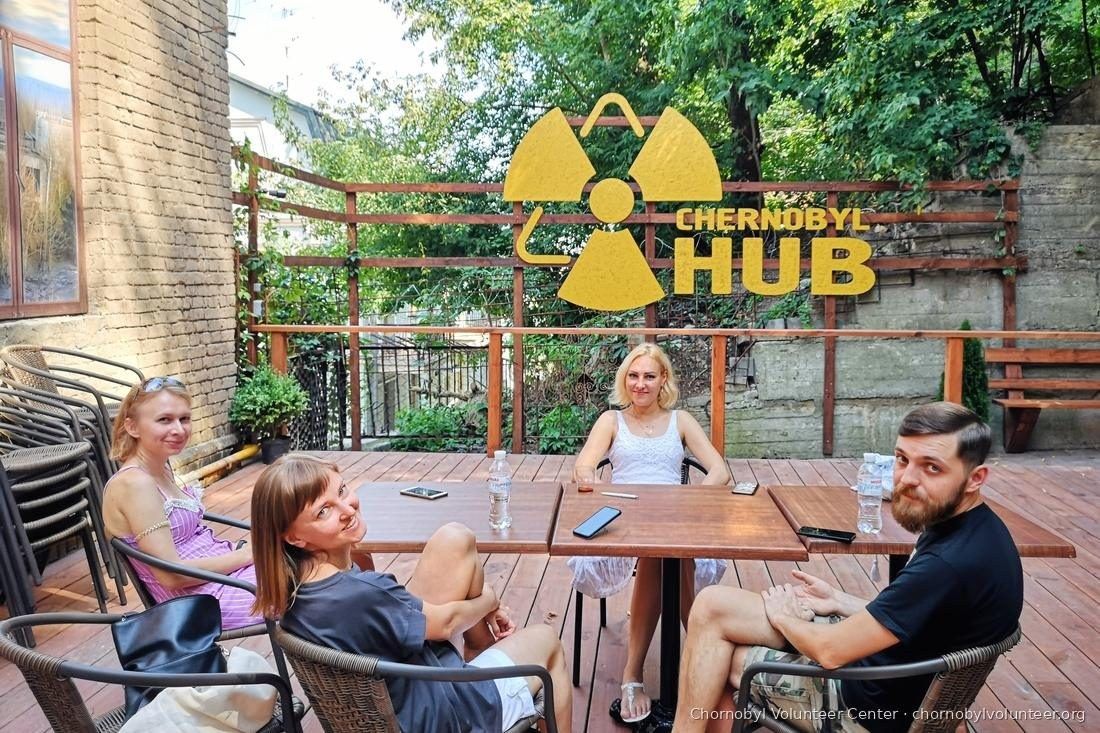
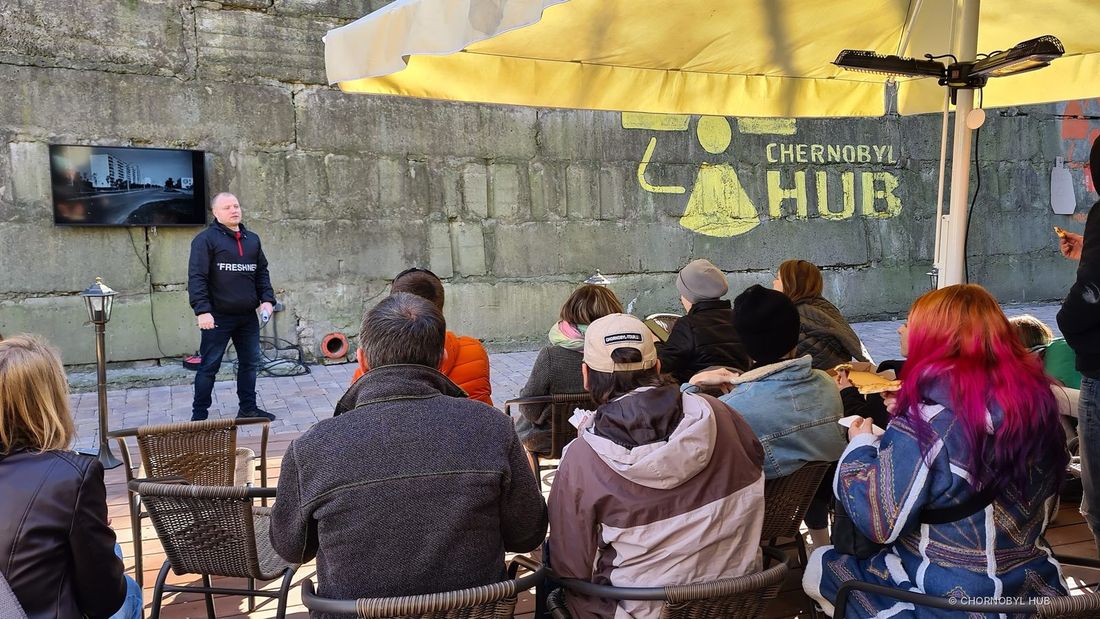
After the online lectures, the participants met in person for the first time at the "Last Bell," the closing session of the course, held at Chernobyl HUB on Andriivskyi Descent. Sergii Mirnyi led the final conversation with three guests: Oleh Nasvit; eco-hydrobiologist and liquidator Yevhen Yakovliev, who worked to protect groundwater from the first days after the accident; and Oleksii Breus, a senior control engineer at Unit 4 who came on shift on the morning of April 26, 1986.
All 14 participants passed the exam: five with excellent marks, six with good marks, two satisfactorily and one on the second attempt. Among them were former residents of Prypiat and Chornobyl-2, a liquidator, a radio host, a dosimetrist, employees of the Chornobyl Nuclear Power Plant and Novarka, a journalist, and a guide and guidebook author from Poland. The graduates received Chornobyl University certificates.
Course Lecturers
Sergii Mirnyi
author of the course; MSc in environmental sciences and a physical chemist by training; researcher of the Chornobyl disaster; pioneer and first researcher of Chornobyl tourism; founder of Chornobyl University; writer and screenwriter; radiation reconnaissance officer and Chornobyl liquidator
Serhii Plokhy
Doctor of Historical Sciences, Professor and Director of the Harvard Ukrainian Research Institute, Shevchenko National Prize laureate, author of Chernobyl: History of a Tragedy
Oleh Nasvit
First Deputy Head of the State Agency of Ukraine for Exclusion Zone Management (2017-2019), expert in radioecology, radiological protection, radioactive waste management and state policy on Chornobyl
Ihor Hudkov
Doctor of Biological Sciences; Professor of Radiobiology and Radioecology at NULES; Academician of the National Academy of Agrarian Sciences of Ukraine; Honored Scientist of Ukraine; author of 20 textbooks; Chornobyl liquidator
Valentyna Vasylenko
PhD in Engineering; Head of the Whole-Body Counting Laboratory, Department of Dosimetry and Radiation Hygiene, National Research Center for Radiation Medicine, Hematology and Oncology, Kyiv
Olena Pareniuk
PhD in Biology; doctoral researcher in Ecology, Radiobiology and Life Safety at NULES; winner of the President of Ukraine's Prize for Young Scientists
Mariia Pokolodna
PhD in Geography; Associate Professor of Tourism at O. M. Beketov National University of Urban Economy in Kharkiv; author of the textbook Organization of Excursion Activities
Kateryna Aslamova
senior guide at CHORNOBYL TOUR, head of the Association of Chornobyl Guides
Maksym Hnatkov
co-founder of an emergency medical response course, certified emergency medical technician (NR-EMT, USA), trainer for units of the Armed Forces of Ukraine, the National Guard, the National Police, the State Emergency Service and the Security Service of Ukraine
Course Program
- Global trends in tourism during the world pandemic.
- The role and place of Chornobyl tourism in developing Ukraine's tourism potential.
- Chornobyl tourism in the context of national and global tourism. The legal and regulatory framework for organizing a tourism product.
- Chornobyl tourism: its history and role in overcoming the consequences of the accident. Informational aspects of emergencies, including radiation emergencies and Chornobyl in particular. The guide as the key figure in Chornobyl tourism. Objectives and structure of the course.
- The guide's profession: the basics of the craft; national and international standards in Chornobyl tourism, history and prospects.
- Radioactivity, ionizing radiation and its types, nuclear energy. The nature of these phenomena and the history of their discovery and use.
- Radiation dosimetry: radiation and exposure doses and their units. Instruments for measuring doses.
- Radiation and living organisms: the effects of different types and modes of ionizing radiation on plants, animals and humans, and the protective responses of living organisms. Radiation protection and radiation safety.
- The Chornobyl accident: background, sequence of events and immediate consequences.
- Overcoming ("liquidating") the consequences of the Chornobyl accident. Technical and environmental aspects. Zoning of the territory contaminated as a result of the Chornobyl disaster. Comparison of the accidents at the Chornobyl and Fukushima Daiichi nuclear power plants and of the efforts to deal with their consequences.
- Health effects of Chornobyl radiation exposure and of the chemical and mechanical (injury) factors associated with the accident.
- The Chornobyl disaster: definition and components (informational, psychological, social, economic, cultural and others). The case of the liquidators.
- Psychological trauma as informational trauma. The "Chornobyl syndrome." Ways of healing and improving the situation.
- Documentary and fiction works about Chornobyl (literature, film and environmental posters). Do they ease or deepen the "Chornobyl syndrome"?
- The Soviet nuclear project and Ukraine. Chornobyl and Ukraine's road to independence. The positive and negative consequences of Chornobyl and its significance for the development of our civilization.
- A guide's procedure for a one-day tour of the Chornobyl Zone.
- Main locations of a one-day tour (Dytiatky checkpoint, the villages of Zalissia and Kopachi, Chornobyl-2, the Chornobyl Nuclear Power Plant, the city of Prypiat, the town of Chornobyl).
- Current activities in the Exclusion Zone. The State Agency of Ukraine for Exclusion Zone Management, its units and enterprises, and their current work.
- Prospects for the sustainable use of territories contaminated as a result of the Chornobyl disaster. People in the Chornobyl Zone: Zone and power plant workers, self-settlers. An overview of the Chornobyl Zone in Belarus.
- Methods for conducting two-day and multi-day tours of the Chornobyl Zone. Main sites to show.
- Typical problem situations on tours and how to resolve them (with real examples). Radiation and general safety of tourists and guides.
- First aid on tours.
- Innovative types of tours. Examples of tours and visitor programs at Hiroshima, Fukushima, Auschwitz, the NASA Space Center, the 9/11 Memorial and other sites. Promising formats of Chornobyl tourism. Chornobyl tourism as a driver of today's stage in overcoming the social and psychological consequences of Chornobyl.
Course Videos
Other Educational Programs
School for Chornobyl Guides
Sergii Mirnyi's idea, which grew into the "Chornobyl Guide" course.
Refresher Training for Guides in the First Days of Lockdown
Lockdown stopped tours to the Zone, and guides used the pause to study.
Online Basic Training Course for Guides with Dragomanov University
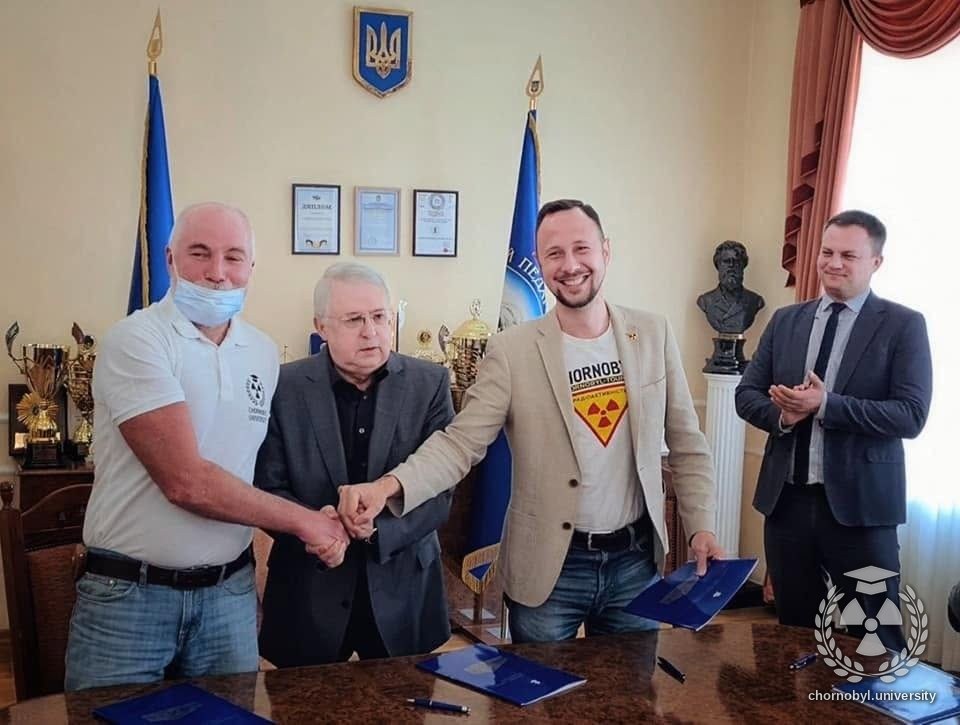
The "Chornobyl Guide" course continued in academic form with a pedagogical university.